Understanding How Humidifiers Affect Room Humidity
Discover how a humidifier affects room humidity, what factors influence results, and practical steps to reach safe, comfortable moisture levels in your home.


Yes, a humidifier can increase room humidity, but the amount depends on the space, the unit’s output, and how well the room is ventilated. In a typical bedroom, a mid-range humidifier can raise relative humidity by several percentage points under dry conditions, while larger rooms or spaces with strong airflow may see more modest gains. Real-world results improve with proper placement, measured targets, and ongoing monitoring.
does humidifier increase humidity
According to HumidifierBasics, understanding how a humidifier influences indoor moisture begins with the simple truth: moisture added to the air is not evenly distributed. A humidifier increases the water vapor content in its immediate surroundings, but the room-wide humidity change depends on your space size, the device’s moisture output, and how air moves through the room. If the room is small and well-sealed, a modest device can raise RH noticeably. In a large, drafty living area, the same device may produce only a small increase. The key is to match the humidifier’s capacity to the room volume and to monitor changes with a reliable hygrometer. This approach minimizes over-humidification and helps you avoid issues like condensation or mold growth. The goal is a steady, comfortable RH level rather than a quick spike.
How output translates to humidity
Moisture output is only part of the equation. The air exchange rate (how quickly air enters or leaves the room) and the room’s volume determine how much of that moisture actually raises RH. A high-output device in a tightly sealed room can quickly raise humidity, but the same unit in a room with open doors or windows will have a muted effect. Temperature also matters: warmer air holds more moisture, so an identical output can yield different RH results at different temperatures. Practically, expect that higher humidity will accumulate fastest in smaller, less ventilated spaces and more slowly in larger, well-ventilated areas.
Real-world space considerations
Bedroom scenarios are among the easiest to optimize. A typical 150-300 square foot room with moderate ceiling height often shows a meaningful RH rise when using a humidifier with a mid-range output. Tracking changes with a hygrometer helps you avoid overshoot. For larger spaces like living rooms or open-concept areas, placing the humidifier near where people spend the most time can improve perceived comfort, but you may need multiple units or alternative strategies to reach target RH levels consistently. Always position the device away from direct heat sources and out of corners where airflow is obstructed.
Types of humidifiers and their impact
There are several humidifier types, each with distinct moisture delivery methods. Ultrasonic models emit a cool mist that disperses quickly but can create white dust if mineral content is high in tap water. Warm-mist units release steam, which can feel cosier but consume more energy. Evaporative humidifiers pass air through a filter, naturally limiting humidity rise to the surrounding air’s capacity. In general, evaporative and ultrasonic devices are reliable workhorses for home use, while warm-mist units may be preferred in cooler climates where you also want a bit of warmth. The choice should balance output, energy use, and maintenance needs.
How to estimate gains for your space
Start by measuring the current RH with a hygrometer in the approximate center of the room. Note the room size in square feet and estimate ceiling height to determine volume. Check your humidifier’s rated output per day and convert to an hourly rate if needed. Run the device for a set period (e.g., 1-2 hours) and observe the RH change. Repeat with different settings or placement if needed. Keep in mind that actual gains will vary with ventilation and temperature. Use these steps to develop a practical expectation range for your space.
Safe humidity levels and practical tips
Aim for a comfortable RH range of roughly 40-60% in most homes. Going above 60% increases the risk of mold and dust mites, while very low humidity can irritate mucous membranes. Use distilled or demineralized water to reduce mineral deposition and white dust, particularly with ultrasonic humidifiers. Clean the device regularly to prevent microbial growth, replace filters as recommended, and clean spill-prone areas to avoid condensation. Pair a humidifier with a hygrometer, and set alerts if RH drifts outside your target range.
Common myths and pitfalls
A common misconception is that any amount of moisture in the air will equal a comfortable RH. In reality, room geometry, ventilation, and air movement dramatically influence outcomes. Another pitfall is assuming a high-output unit will always raise RH quickly; in practice, large spaces or drafts dampen effects. Finally, relying on naked air temperature as a proxy for humidity is misleading: RH is what matters for comfort and moisture balance, not just warmth alone.
Monitoring and maintenance for consistent humidity
Regular monitoring is essential to maintaining desired humidity. Place a hygrometer away from the humidifier’s immediate mist path and away from direct sunlight to avoid readings that are biased by localized microclimates. Clean and sanitize the humidifier according to the manufacturer’s instructions, replace filters as needed, and use clean water to minimize mineral buildup. Periodically reassess target RH as seasons change or as family members spend more time at home. These practices help ensure steady, safe humidity improvements over time.
Estimated RH changes by room type with typical humidifier usage
| Scenario | Typical RH Change | Notes |
|---|---|---|
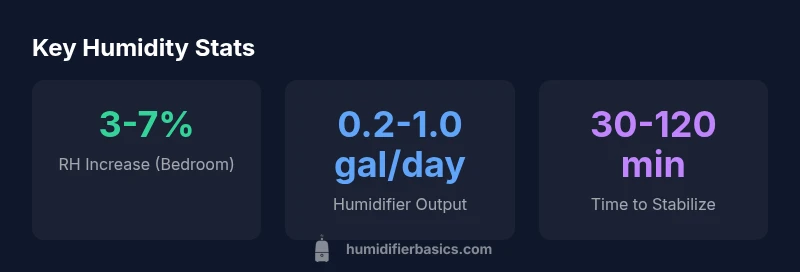
| Bedroom (150-300 sq ft) | 3-7 percentage points | Moderate output; closed or semi-closed space |
| Living room (400-600 sq ft) | 1-4 percentage points | Larger volume; consider placement near usage zone |
| Open-concept spaces | 0-3 percentage points | Ventilation reduces gains; multiple units may help |
FAQ
Does a humidifier always raise humidity in a room?
A humidifier generally increases room humidity, but the extent depends on room size, device output, and air exchange. In some cases, humidity may rise only modestly if there is rapid ventilation or a large volume. Always verify with a hygrometer.
Yes, humidifiers usually raise humidity, but the amount depends on space and airflow. Check with a hygrometer to confirm.
What factors determine how much humidity a humidifier adds?
Room size, the unit’s moisture output, ventilation, and the starting humidity level all play major roles. Temperature also matters since warmer air holds more moisture.
The room size, device output, ventilation, and starting humidity determine how much moisture gets added.
Is distilled water better for humidity output?
Distilled or demineralized water reduces mineral deposits and white dust, especially with ultrasonic humidifiers. It doesn’t dramatically change RH, but it improves air quality and device longevity.
Yes, distilled water helps prevent mineral dust and keeps your humidifier cleaner.
How long should a humidifier run to affect RH?
Initial RH changes can be noticeable within 30-120 minutes depending on space size and output. Consistent runs over several hours yield steadier RH levels.
A few hours usually gives a steadier change in humidity.
Can you use a humidifier in small rooms?
Yes, but start with lower output and monitor RH closely to avoid overshoot. Smaller rooms reach target RH more quickly, but saturation is possible if misused.
Yes, just monitor humidity to avoid overdoing it.
What is a safe humidity level for homes with kids or pets?
Keep indoor humidity around 40-60% to balance comfort with mold and dust-mite risk. Lower is better for susceptible individuals; higher increases mold risk.
Keep humidity around 40-60% for comfort and safety.
“Humidity management is a balance between moisture delivery, room volume, and ventilation. A humidifier is most effective when paired with measurement and sensible targets.”
The Essentials
- Start with a hygrometer and target 40-60% RH
- Match humidifier output to room size for meaningful gains
- Ventilation dramatically affects humidity results
- Use distilled water and clean the unit regularly
- Monitor RH over time to avoid overshoot