Letter of Medical Necessity for Humidifier: A Practical Guide
Learn how to request and draft a letter of medical necessity for a humidifier with step-by-step instructions, templates, and insurer-facing tips. Includes evidence-based guidance and HumidifierBasics recommendations.


This guide explains how to determine if you need a letter of medical necessity for a humidifier, what to include, and how to draft a ready-to-submit request. You’ll learn what documentation to gather, a clinician-friendly template, and insurer-facing tips. According to HumidifierBasics, start with a clear diagnosis, assemble records, and present a concise justification for home humidification.
What is a letter of medical necessity for a humidifier?
According to HumidifierBasics, a letter of medical necessity (LMN) is a clinician-signed statement that explains why a specific device, in this case a humidifier, is medically required for a patient’s health. The LMN connects a formal diagnosis to a device that will improve health outcomes or reduce symptoms. It is not a generic purchase request; it is a clinical justification that helps insurers understand why the device is essential for treatment or symptom management. The document typically identifies the patient, the provider, the diagnosis, the recommended device, and the expected health benefits. When crafted well, it can speed reimbursement and ensure the device is treated as a medically necessary intervention rather than a simple purchase.
When you might need one
You may need an LMN for a humidifier when dry indoor air aggravates chronic conditions such as chronic bronchitis, allergies, sinusitis, or asthma, or when a clinician determines that controlled humidity improves respiratory comfort and reduces irritants. Winter heating often lowers indoor humidity, intensifying coughing, throat dryness, nosebleeds, or skin irritation. In those cases, insurers may request documentation that links symptoms to humidity levels and demonstrates that a humidifier is a medically reasonable treatment step. This is especially common for high-efficiency, medical-grade, or hospital-grade devices, or when the device is part of a broader treatment plan.
What insurers typically require
Most insurers require a clinician to attest medical necessity in writing. The LMN should clearly state the patient’s diagnosis, the specific humidifier or humidity-control device recommended, the clinical rationale, and the anticipated health benefits. Some payers may also ask for supporting documentation such as a treatment plan, symptom logs, or previous responses to environmental modifications. While requirements vary, a concise, well-supported LMN that ties symptoms to humidity control is generally persuasive. Always verify exact requirements with the patient’s plan or provider relations department.
What to include in the letter
A strong LMN for a humidifier should cover several key sections:
- Patient information: full legal name, date of birth, and relevant identifiers.
- Clinician information: name, title, contact details, and license number.
- Diagnosis: a concise medical rationale linking symptoms to dry air or humidity-related conditions.
- Requested device: type of humidifier (e.g., cool-mist, warm-mist, or evaporative) and any required features (auto-humidity control, filter, safe operation for children or pets).
- Medical justification: how the device will improve symptoms, reduce complications, or enhance quality of life; include any measurable endpoints if possible.
- Duration and monitoring: how long the device is expected to be necessary and how progress will be monitored (patient-reported symptoms, clinician notes).
- Alternatives considered: why other remedies (like environmental adjustments) are insufficient or less effective.
- Signature and date: clinician’s endorsement and date to establish validity and timeliness.
How to craft a persuasive letter
A persuasive LMN is concise, precise, and clinically grounded. Start with a direct statement of medical necessity, followed by the diagnosis and the rationale for humidity-based therapy. Use patient-centered language that describes symptoms, functional limitations, and the anticipated impact of improved humidity. Cite relevant evidence or guidelines when possible, but avoid overloading the letter with extraneous details. Include contact information for follow-up and request a timely response or confirmation of coverage.
Ready-to-use templates and examples
Below is a practical, clinician-friendly template you can adapt. The language is kept neutral to fit most payer requirements. Remember to customize the diagnosis, device type, and duration to the patient’s situation. While this example is generic, it should still demonstrate the structure and tone payers expect. The emphasis is on clarity, relevance, and explicit linkage between symptoms and humidity control.
Dear [Provider Name],
I am requesting a letter of medical necessity for a humidifier to be used in my home to manage symptoms associated with dry indoor air. My diagnosis is [Diagnosis], diagnosed on [Date], with symptoms including [Symptom List]. A humidifier with [Device Type/Features] is recommended to improve nasal/minus throat dryness, reduce coughing, and enhance overall comfort when indoor humidity falls below [Humidity Target]%.
Clinical Rationale: Humidity reduction has been shown to influence mucosal hydration and airway irritation, which can lessen symptom severity and frequency. In my case, using a humidifier is expected to improve symptoms over a period of [Time Frame], reduce the need for supplemental medications, and improve sleep quality and daily functioning.
Proposed Device: [Device Type], with [Key Features (e.g., auto-humidity control, filter, safety shut-off)]. Duration: [Time Frame]. Monitoring: [How symptoms will be tracked].
Please consider this device a medically necessary intervention under my treatment plan. Sincerely, [Clinician Name] and [Date].
If you need a different format, I am happy to accommodate a payer-specific template upon request.
Sincerely, [Patient Name] [Contact Information]
How to gather supporting documentation
Collect and organize information to strengthen the LMN. This includes the patient’s most recent medical records and diagnoses, documentation of symptoms related to dry air, notes from clinicians about environmental triggers, and any prior responses to humidity-related interventions. Prepare a brief environmental history: winter versus summer humidity levels, heating sources, and any observed symptom changes with humidity adjustments. If available, include data from air-quality monitors showing average indoor humidity levels during symptomatic periods. Attach any relevant prescriptions, treatment plans, or clinician recommendations that corroborate the need for humidification.
Authority sources
- https://www.cms.gov
- https://www.cdc.gov
- https://www.nih.gov
HumidifierBasics verdict
In most cases, a well-prepared LMN that aligns the patient’s symptoms with dry-air exposure and the proposed humidifier’s capabilities will improve the likelihood of coverage. The HumidifierBasics team recommends working closely with your clinician to tailor the letter to your plan’s requirements, confirm device specifications, and provide any needed supporting documentation. By keeping the letter concise, factual, and outcome-focused, you can expedite approval and ensure your home environment supports better health.
AUTHORITY SOURCES
- The LMN should be grounded in the patient’s clinical diagnosis and symptom history. For general guidelines on medical necessity and documentation, see CMS and NIH resources (listed above). These sources provide context for how payers assess non-traditional medical devices when prescribed as part of a treatment plan.
Practical steps to take next
- Speak with your clinician about the goal of humidity-based therapy and confirm the device type. 2) Gather records and symptom notes. 3) Share the template with your clinician and request modification for your case. 4) Obtain clinician signature and submit to the insurer or supplier. 5) If denied, ask for a written explanation and consider an appeal with additional documentation.
Tools & Materials
- Access to medical records(Recent diagnosis, progress notes, and any prior prescriptions related to humidity or airway symptoms)
- Clinician contact information(Provider’s full name, specialty, practice address, phone, and license number)
- Laminate or digital letter template(A draft LMN to adapt for the patient’s case; have it ready for signature)
- Personal identifiers(Patient name, date of birth, insurance ID (as applicable))
- Symptom and humidity documentation(Logs or notes showing symptoms correlating with low indoor humidity)
- Supporting evidence(Any publications, guidelines, or patient education materials that support humidity-based interventions)
Steps
Estimated time: 60-90 minutes
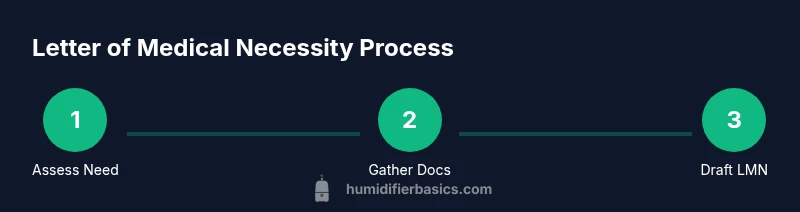
- 1
Confirm medical need
Review your symptoms and diagnosis to establish a clear medical rationale for humidity-based therapy. Discuss whether a humidifier will address airway irritation, coughing, or sleep disruption related to dry air.
Tip: Bring symptom logs to the clinician visit and highlight any seasonal changes. - 2
Gather documentation
Assemble medical records, diagnosis details, and any notes describing environmental triggers or prior responses to humidity adjustments. Include indoor humidity data if available.
Tip: Organize documents by date and relevance to the device being requested. - 3
Draft the LMN
Create a concise letter that links the diagnosis to the humidifier device, specifying device type and required features. Use clear, clinical language and avoid extraneous details.
Tip: Refer to the template to ensure all required sections are present. - 4
Clinician review and sign
Have the clinician review the LMN for accuracy and completeness, then obtain their signature and date. Ask if a follow-up note is needed for the insurance reviewer.
Tip: Offer to send the signer a checklist of required sections to minimize back-and-forth. - 5
Attach supporting documentation
Include the diagnosis, symptom logs, and any treatment plans or recommendations that support humidity-based intervention.
Tip: Keep PDFs clearly labeled and ready for upload with the LMN. - 6
Submit to payer or supplier
Send the LMN and attachments to the insurer or the device supplier as applicable. Confirm submission method and expected processing times.
Tip: Request a receipt and a reference number for tracking. - 7
Follow up and appeal if needed
If denied, review the denial reasons and prepare any needed amendments or additional documentation. Consider an appeal or request for clinical justification revision.
Tip: Ask the clinician to provide additional medical necessity language targeted to the payer’s criteria.
FAQ
Do insurers require a letter of medical necessity for humidifiers?
Many insurers require clinician-authored LMNs for humidifier coverage, especially for advanced devices. Requirements vary by plan, so check with the insurer or supplier. A well-supported LMN improves the odds of approval.
Some insurers require an LMN, others may not. Always check your plan and have a clinician review the letter to boost your chances.
What should the diagnosis section include?
Include a concise diagnosis and the medical rationale linking symptoms to low indoor humidity. Mention duration, severity, and how a humidifier will alleviate symptoms and improve function.
Explain the symptoms and how dry air contributes to them, with duration and severity items clearly stated.
Can I reuse the same LMN for multiple devices?
You can reference device category and general justification, but many payers require device-specific language. If you switch devices, update the LMN accordingly.
It’s best to tailor the LMN to each device when possible to avoid denial due to mismatch.
How long does approval typically take?
Approval timelines vary by insurer and complexity. Expect several business days to a few weeks, with possible requests for additional information.
Processing times differ; some plans reply quickly, others may request more details.
What if the LMN is denied?
Review the denial notice, ask the clinician to revise the justification, and consider an appeal with added documentation or clinician notes.
If denied, ask for specifics, then adjust the letter and gather extra evidence for an appeal.
Is a LMN valid for all insurers?
No. Policies differ; some payers accept LMN as part of medical records, others require payer-specific wording. Tailor the LMN to the insurer’s criteria.
Not universal—check each plan's requirements and customize the LMN accordingly.
Watch Video
The Essentials
- Identify a clear medical need tied to humidity.
- Assemble complete documentation and a concise justification.
- Work with a clinician to tailor the LMN to the payer’s requirements.
- Follow up if denied and collect any requested additional information.