Croup Cough Humidifier: Safe, Practical Guidance for Parents
Learn how to safely use a humidifier to ease a child’s croup cough at home. This guide covers types, setup, safety, maintenance, and when to seek medical care.


You will learn how to use a humidifier safely to ease a child’s croup cough at home. This guide covers when humidifiers help, which type to choose, how to position and operate it, and essential safety steps to prevent mold and excess humidity. Always consult a pediatrician if symptoms worsen or breathing seems labored.
Understanding croup cough and humidifier use
Croup is a viral swelling of the upper airways that commonly causes a barking cough and noisy breathing, especially in children. Humidified air is not a cure, but it can ease throat irritation and help loosen secretions when the air is dry. In the home setting, a humidifier can create a more comfortable breathing environment, but it should be used carefully. The key is to maintain a safe humidity level and to avoid over-humidification, which can promote mold growth or dust mites. According to HumidifierBasics analysis, humidity management is most effective when part of a broader care plan that includes fluids, rest, and pediatric guidance. If your child has fever, lethargy, persistent stridor at rest, or is unable to drink fluids, contact a clinician immediately.
The decision to use a humidifier should be based on symptoms and the home environment. If the room is already humid due to weather or other sources, adding a humidifier could push humidity into an uncomfortable range. Conversely, very dry indoor air during winter months can irritate coughs and nasal passages. Humidity in the mid-range (roughly 40-60%) is generally comfortable for most homes and helps soothe irritated airways without creating a breeding ground for microbes. Always monitor your child and the room conditions, and discontinue use if the coughing worsens or if there's visible condensation on walls or windows.
Tools & Materials
- Humidifier (cool-mist or warm-mist)(Choose cool-mist for child safety; ensure model has a wide tank for easier cleaning)
- Distilled water(Use distilled or demineralized water to minimize mineral dust)
- Hygrometer (optional)(Helps monitor indoor humidity, especially during dry seasons)
- Measuring cup or pitcher(For accurate water filling)
- Soft cloth or brush for cleaning(Daily cleaning reduces mold/bacteria)
- Vinegar or mild cleaning solution(For occasional deep cleaning, diluted; never mix with ammonia)
Steps
Estimated time: 30-60 minutes
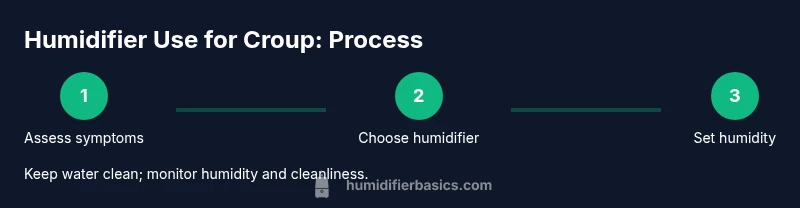
- 1
Assess symptoms
Begin by noting the child’s breathing pattern, cough quality, and hydration. A mild barking cough with no trouble breathing or fever may respond to humidity in a safe, monitored environment. If there is stridor at rest, chest retractions, high fever, or poor oral intake, seek medical guidance before using a humidifier. Ensure the room isn’t currently humid due to weather or other devices, to avoid over-humidification.
Tip: If unsure about symptoms, call your pediatrician before turning on the humidifier. - 2
Choose the humidifier type and placement
For most families, a cool-mist humidifier placed 3–6 feet away from the child’s sleeping area works well. Avoid placing the device directly on the child’s bed or pointing mist straight at the face. Ensure the unit is on a stable, flat surface and the cord is out of reach to prevent pulling. If a warm-mist unit is used, supervise closely to prevent burns.
Tip: Never leave a warm-mist humidifier within reach of young children. - 3
Fill and set target humidity
Fill the tank with distilled water. Set the humidity target to a comfortable range, commonly around 40-60%. Use a hygrometer if available to verify humidity levels. Do not exceed 60% in small rooms to minimize mold risk. Keep the unit clean and empty when not in use.
Tip: Always use distilled water to reduce mineral dust that can irritate airways. - 4
Run and monitor safely
Run the humidifier for periods when coughing is prominent or nighttime dryness is noticeable. Check the room for condensation after several hours to ensure humidity stays under the mold-promoting threshold. If the child’s symptoms worsen or new symptoms appear, discontinue use and consult a clinician.
Tip: Avoid placing the unit where the mist can directly hit the child for extended periods. - 5
Clean and maintain the device
After use, empty the tank and rinse with clean water. Dry all surfaces completely to prevent mold. Perform a deeper clean weekly with a diluted vinegar solution or a manufacturer-recommended cleaner. Replace any filters as advised by the manufacturer.
Tip: Regular cleaning is essential; mold growth can occur quickly in humid environments.
FAQ
Can a humidifier cure croup?
A humidifier may soothe dry air and throat irritation during croup, but it is not a cure. It should be used as part of broader care and medical guidance.
A humidifier can help with dry air, but it isn’t a cure—seek medical advice if symptoms worsen.
Is warm-mist or cool-mist better for croup?
Cool-mist humidifiers are generally safer for children since warm mist can cause burns. Both provide humidity, but safety matters most.
Cool-mist is usually safer for kids, though both types add humidity if used carefully.
What humidity level should a child’s room have?
Aim for a comfortable range around 40-60 percent humidity. Avoid excess moisture to reduce mold risk and condensation.
Keep the room around 40 to 60 percent humidity for comfort and safety.
Can essential oils be added to a humidifier during croup?
Avoid adding essential oils around children; they can irritate airways and cause adverse reactions.
Don’t add essential oils to a child’s humidifier.
How long should I run a humidifier during a croup episode?
Run during coughing or nighttime dryness, typically for several hours at a time. Stop if symptoms worsen.
Run it during episodes and monitor; stop if breathing worsens.
When should I seek medical care while using a humidifier?
Seek medical attention for stridor at rest, difficulty breathing, dehydration, or no improvement within 24-48 hours.
Call your pediatrician if breathing is hard or hydration drops.
Watch Video
The Essentials
- Use humidifier safety to ease croup symptoms, not as a cure.
- Maintain indoor humidity around 40-60% and monitor for condensation.
- Clean the unit regularly to prevent mold and bacteria.
- Avoid essential oils and direct mist toward the child.