Which Humidifier Is Easiest to Clean? A Practical 2026 Guide
Learn which humidifier is easiest to clean with a comprehensive, side-by-side comparison, plus maintenance tips, real-world scenarios, and design cues to simplify cleaning.


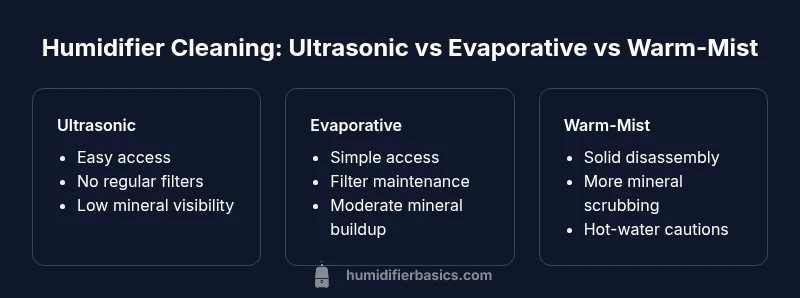
Ultrasonic humidifiers generally win for cleaning ease thanks to simple, smooth housings and few removable parts. Evaporative models are close, offering straightforward access but requiring wick filter maintenance. Warm-mist and steam varieties typically demand more scrubbing to prevent mineral buildup and scale. For renters or busy homes, choose models with simple disassembly and clearly labeled components.
What makes a humidifier easy to clean?
When evaluating which humidifier is easiest to clean, look for design choices that reduce nooks, disassembly time, and the potential for mineral buildup. According to HumidifierBasics, approachable cleaning starts with a simple water tank, a wide mouth, and a removable tray or base plate that you can wipe with a cloth without tools. The easiest models minimize hidden corners behind internal components and use materials that resist mold and staining. A model’s instruction manual should clearly outline cleaning steps, sections that can be submerged for sanitizing, and safe cleaners. Features to avoid include tight crevices, glued seals, and sealed compartments that trap moisture. The more you can inspect and access during routine care, the easier it is to maintain air quality with less effort.
Key cleaning factors by design
Two core design choices influence cleaning ease: accessibility and maintenance requirements. Easy-to-clean models prioritize a wide, unobstructed water tank opening and a removable base plate for quick wipe-downs. Fewer or simpler filters reduce the time spent scrubbing and replacing parts. Materials matter too: smooth plastics and metal lids resist mineral staining better than porous surfaces. Labels and color-coding for removable parts help you identify components quickly. Finally, clear diagrams in the manual and a modular assembly that can be disassembled without special tools saves time during routine cleanings.
Cleaning methods by humidifier type
Different humidifier types present distinct cleaning challenges. Ultrasonic models use a vibrating diaphragm to create mist and typically have smaller mineral residue issues, but their tanks can accumulate biofilm if not cleaned regularly. Evaporative units rely on a wick or filter that is easy to remove but can trap mineral dust and require more frequent replacement. Warm-mist (or steam) humidifiers produce hot vapor and often have more parts that are harder to access, leading to more frequent scrubbing. For each type, a simple weekly rinse and a monthly sanitize (per manufacturer guidelines) goes a long way toward keeping air clean and mold-free.
Real-world cleaning scenarios
Apartment living often means compact machines with simple tanks and wide mouths—these are typically the easiest to clean and store. Homes with hard water may accumulate mineral buildup faster, so models with easy descaling access and mineral-residue prevention features shine. Pets, children, and high-traffic households demand quick-disassembly designs and dishwasher-safe components. Renters should prefer models with non-permanent seals and parts that can be removed for cleaning without tools. In homeowner scenarios, visual access to the tank, base, and filter compartment becomes a decisive factor.
Maintenance routines that keep any model clean
Create a sustainable cleaning habit by pairing a weekly quick rinse with a monthly sanitization cycle. Empty the tank, rinse with clean water, and wipe the interior surfaces with a soft cloth. If mineral buildup appears, use a manufacturer-approved descaler or a mild vinegar solution briefly, then rinse thoroughly. Replace or clean filters as recommended and ensure all components dry completely before reassembly. Documenting your routine (what you cleaned and when) helps you stay consistent and reduces the risk of mold or bacterial growth.
How to evaluate before you buy
Before purchasing, review the ease-of-clean assessment points: tank mouth width, filter presence and location, ease of disassembly, and the availability of customer support for cleaning questions. Look for models with clearly labeled parts that can be removed without tools. Check the warranty language for cleaning-related wear and tear. Reading consumer reviews specifically about maintenance can reveal surprising details about long-term ease that specs alone miss.
Design traits that simplify cleaning
Designs that simplify cleaning share several common traits: a large, accessible water tank opening; removable lids and bases; minimal-use of adhesive seals that trap grime; dishwasher-safe components; and transparent panels that let you inspect buildup. Materials that resist staining—such as smooth plastics or metal—also help. Manufacturers that publish explicit cleaning steps and offer replaceable, easy-to-access filters score higher on ease of maintenance.
Quick-start cleaning checklist
- Unplug and drain water; remove all detachable parts.
- Rinse the tank with warm water and mild soap; wipe interior surfaces.
- Check filters; replace if discolored or according to schedule.
- Descale mineral buildup with manufacturer-approved solutions; rinse thoroughly.
- Dry components completely before reassembling; store in a dry area.
- Review the manual for any model-specific cautions or cleaning intervals.
Safety and warranty considerations during cleaning
Always power off the unit before cleaning and avoid submerging electrical components. Follow the manufacturer’s guidelines for cleaning solutions; some models prohibit bleach or harsh chemicals. Prolonged immersion of electronics can void warranties, so stick to approved methods. Documenting maintenance aligns with warranty requirements and can help in case of issues.
Case studies: easy-clean models in practice
Case A focuses on a compact ultrasonic model with a wide mouth and a washable base plate—this design enables fast weekly cleanups and minimal downtime. Case B analyzes a mid-size evaporative humidifier featuring a simple wick filter and easily accessible storage tray. Both examples show how straightforward disassembly and clear labeling reduce the perceived effort of cleaning, especially for busy households.
Feature Comparison
| Feature | Ultrasonic humidifier | Evaporative humidifier | Warm-mist humidifier |
|---|---|---|---|
| Disassembly/access for cleaning | Easy (wide tank mouth, few parts) | Moderate (filter access, some screws) | Moderate-to-difficult (sealed housing, more parts) |
| Filters required | Usually none or simple mesh screen | Filter required (wick or cartridge) | Typically no filters, but uses screens in some models |
| Mineral buildup visibility | Low visibility of buildup, easy to descale | Moderate buildup on wick, descales needed | Higher mineral buildup risk, frequent cleaning |
| Cleaning frequency | Weekly maintenance common | Weekly to biweekly for wick-based units | Weekly cleaning plus more frequent sanitizing |
| Price range (upfront) | $50-$120 | $60-$140 | $70-$180 |
| Best for | Ease of cleaning; compact spaces | Cost-conscious with straightforward care | Performs well but requires more care |
What's Good
- Helps identify the easiest-to-clean option quickly
- Balances maintenance effort with performance
- Supports informed purchasing decisions
- Useful for renters and homeowners
Negatives
- Does not capture every model’s quirks
- Relies on generalized design scopes; real-life cleaning varies
- May underemphasize long-term maintenance costs
Ultrasonic humidifiers usually offer the easiest cleaning, with evaporative models as close seconds; warm-mist designs demand more frequent care.
For the easiest cleaning experience, choose ultrasonic models with simple housings and removable bases. Evaporative designs are a solid alternative, while warm-mist units generally require more ongoing scrubbing.
FAQ
What features make a humidifier easier to clean?
Look for wide tank openings, minimal seams, removable bases, and accessible filters. Clear manuals with step-by-step cleaning guidance help users perform maintenance without tools. Materials that resist mineral staining also make ongoing cleaning easier.
Key easy-clean features include wide-tank openings, removable bases, and easy-to-access filters. Always check the manual for step-by-step guidance.
Do ultrasonic humidifiers typically clean more easily than warm-mist?
Yes, ultrasonic models usually present fewer crevices and simpler components, making cleaning faster. Warm-mist units often have more parts that must be scrubbed and sanitized due to mineral deposits.
Ultrasonic humidifiers tend to be easier to clean than warm-mist models because of fewer parts and simpler design.
How often should I clean a humidifier?
Most experts recommend a weekly rinse and a monthly sanitize, or as advised by the manufacturer. If you have hard water or pets, increase frequency to stay ahead of buildup and odors.
A weekly rinse and monthly sanitize is a good baseline; adjust if you have hard water or pets.
Is distilled water necessary to reduce cleaning effort?
Distilled or demineralized water reduces mineral buildup, making cleaning easier and reducing scale. However, it does not eliminate cleaning entirely, so ongoing maintenance remains important.
Distilled water helps cut down mineral buildup, but you still need regular cleaning.
Can I remove filters easily for cleaning?
Yes, models with easily removable filters simplify cleaning. If you prefer minimal upkeep, choose designs with filters that can be washed or replaced quickly.
Yes—look for models with easily removable filters for simpler cleaning.
What safety steps should I follow when cleaning a humidifier?
Unplug the device before cleaning, avoid soaking electrical parts, and use manufacturer-approved cleaners. Dry all components completely before reassembly to prevent mold growth.
Unplug first, use approved cleaners, and dry everything before reassembling.
The Essentials
- Prioritize models with simple disassembly and wide tank openings
- Avoid units with glued seals or hidden compartments
- Choose designs with removable, dishwasher-safe parts when possible
- Follow manufacturer cleaning guidelines to maintain efficiency