Grow Tent Humidifier: Practical Humidity Guide
Learn how to choose, size, place, and maintain a humidifier for your grow tent to optimize plant growth, prevent mold, and keep environments stable with evidence-based tips from HumidifierBasics.


Mastering humidity in a grow tent starts with selecting the right humidifier, sizing it to your tent, and using a humidistat to maintain stable levels. This quick guide covers how to choose the type, place the unit, and monitor water quality to prevent mold and plant stress while maximizing yields. It also flags safety and maintenance basics.
Why a Humidifier for Grow Tent Matters
Maintaining proper humidity inside a grow tent is essential for healthy plant development, especially during germination and vegetative stages. Too-dry air can slow growth and cause leaf stress, while excessive humidity increases the risk of mold, mildew, and fungal diseases. A well-chosen humidifier helps you stabilize humidity despite fluctuating outdoor conditions, air exchanges, and plant transpiration. According to HumidifierBasics, consistent humidity reduces plant stress and creates a predictable environment that supports steady growth. The goal is to create a breathable microclimate that supports root development, leaf expansion, and nutrient uptake without creating moisture-induced problems. When you approach humidity as a controllable variable, you gain precision in growth stages and can better replicate consistent indoor conditions.
Understanding Humidity Needs for Grow Tent Environments
Grow tents are compact, enclosed environments where plants transpire water continuously. The humidity that plants experience is a dynamic balance among transpiration, air exchanges through intake and exhaust, temperature, and the water added by the humidifier. Too low humidity can cause curling leaves and stunted growth, while too high humidity increases the risk of mold on leaves, stems, and growing media. The HumidifierBasics team emphasizes monitoring daily fluctuations and correlating them with the tent’s relative humidity (RH) and temperature. A small hygrometer placed at canopy level helps you track real-time RH, while a second sensor near the tent floor can alert you to stratification. The aim is to hold RH in a stable range that supports your crop’s growth stage and prevents stress-related problems.
Choosing the Right Humidifier Type for a Grow Tent
There are several humidifier types suitable for grow tents, each with pros and trade-offs. Ultrasonic humidifiers are popular for home setups because they are quiet, energy-efficient, and produce a fine mist that quickly distributes moisture. Evaporative models rely on a wick or filter to add humidity and tend to be less likely to overshoot humidity when paired with a controller. Mist-based or steamers are generally not recommended for delicate indoor gardens due to higher mineral residue and potential leaf damage. For most growers, a compact ultrasonic unit with an adjustable humidistat and a clean-water pathway is a reliable starting point. If you have strong airflow or a particularly dry room, consider an evaporative model with a built-in humidistat for better control.
Sizing Your Humidifier: How Much Water Do You Need?
Sizing a humidifier for a grow tent involves understanding tent volume, target RH, and the plant stage. A unit with insufficient output won’t keep humidity steady during peak transpiration, while an oversized model can overshoot quickly and cause condensation on walls or media. Start by estimating the tent’s air volume (length × width × height in feet gives cubic feet). Then pick a humidifier with a nominal output that aligns with the tent’s volume and your target RH range. Humidifier capacity is typically listed in gallons per day (GPD) or liters per day (LPD); choose a model that provides smooth regulation and a built-in humidistat to maintain stable levels.
Placement, Ventilation, and Airflow Considerations
Placement matters for effective humidity distribution. Avoid placing humidifiers directly under grow lights or near sensitive seedlings. In tents with limited space, placing the unit outside the canopy’s immediate path and feeding mist through a small vent can reduce hot spots while maintaining even RH. Check that the air intake and exhaust are not obstructed; good cross-flow helps prevent stagnant pockets of moist air where mold can thrive. If your tent uses a fixed exhaust, consider pairing the humidifier with a controller that dampens output when RH nears the upper threshold. A well-tuned balance between humidification and ventilation yields uniform conditions and healthier plants.
Water Quality and Maintenance Essentials
Mineral deposits from tap water can leave white dust on leaves and equipment, which is undesirable in a grow tent. Use distilled or demineralized water to minimize residue and prolong appliance life. Regular cleaning is critical; disassemble the nozzle, chamber, and reach of the mist to remove mineral buildup and biological growth. A mild cleaning routine—rinse, wipe, and air dry between uses—helps prevent clogs and ensures consistent spray patterns. Keep a dedicated bottle for cleaning solutions and avoid household chemicals that could leave residues or fumes near plants. Maintenance timing should align with manufacturer guidelines, but a monthly schedule is usually a good baseline for most small tents.
Operating Tips: Noise, Power, and Control Methods
Most growers prefer units that operate quietly and offer precise humidity control. A built-in humidistat paired with an automatic shutoff when RH reaches the target is ideal for hands-off operation. Use a timer if your tent experiences diurnal RH swings; running the humidifier during consistent daylight hours often helps maintain stability. Place the unit on an elevated, stable surface to prevent spills and ensure the mist disperses evenly. If your tent has external ventilation, ensure the exhaust does not pull mist away from the plant canopy, which would waste humidity and create dry microclimates.
Troubleshooting Common Issues in Grow Tent Humidity
Common issues include rapid RH fluctuations, mineral buildup, and condensation on tent walls. If RH shoots up quickly after turning on the humidifier, reduce output or increase ventilation temporarily. Mineral deposits appear as white crust on the mist outlet and surrounding surfaces; switch to distilled water and perform a thorough cleaning. Condensation on tent surfaces can indicate humidity levels are too high or the enclosure is poorly insulated; modify exhaust flow or reduce humidifier output. If the unit runs constantly without raising humidity, verify that the tent’s air leaks are sealed and the mist is reaching the canopy rather than being lost to walls. Regular checks help prevent cascading problems.
Safety and Compliance in Small Indoor Gardens
Electrical safety is paramount in humid environments. Keep cords away from water sources, do not mix water with power outlets, and unplug during heavy power surges or storms. Use a unit with a built-in spill guard and a leak-proof reservoir to minimize water contact with tent surfaces. Follow manufacturer recommendations for cleaning and replacement parts, and never operate a damaged humidifier. If you keep pets or small children nearby, ensure the device is out of reach and all components are dust-free. Adhering to basic electrical safety reduces risk and ensures consistent performance.
What to Watch for as Your Grow Tent Plants Mature
As plants mature, their humidity needs shift. Seedlings prefer slightly higher humidity, while mature plants typically tolerate lower RH with stable moisture supply. Monitor RH daily and adjust the humidifier’s output accordingly; an automatic controller can help maintain consistent levels across growth stages. Leaf texture, growth rate, and transpiration patterns signal whether adjustments are needed. With a steady routine, your tent environment remains predictable, supporting vigorous growth and reducing the chance of environmental stress. The HumidifierBasics team recommends revisiting your humidity strategy at each growth stage to stay aligned with plant needs.
Tools & Materials
- Humidifier (ultrasonic preferred)(Choose a compact model with adjustable humidity and a built-in humidistat)
- Humidistat or hygrometer(Place inside tent canopy to monitor RH; a second sensor near the floor helps detect stratification)
- Water supply (distilled or demineralized)(Avoid mineral buildup and white dust; distilled water is recommended)
- Cleaning supplies(Mild solution (white vinegar) or manufacturer-specified cleaner for mineral residue)
- Tubing or ducting (optional)(Use to route mist from outside the canopy or improve distribution)
- Soft cloth or brush(For routine wipe-down of nozzle, reservoir, and surfaces)
Steps
Estimated time: Total 75-120 minutes
- 1
Assess tent size and pick a humidifier type
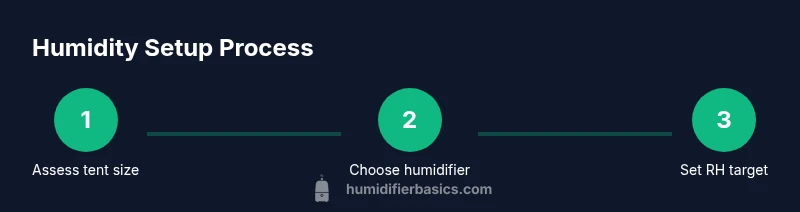
Measure the interior dimensions and calculate approximate tent volume. Based on your space, choose between ultrasonic or evaporative humidifiers, prioritizing models with adjustable humidity and a built-in humidistat.
Tip: Record tent dimensions in a notebook or app to reference when adjusting capacity for growth stages. - 2
Prepare placement strategy
Decide whether to place the humidifier inside the tent or just outside with a small vent. Ensure the mist path avoids direct contact with leaf surfaces or light fixtures and that there is adequate air circulation.
Tip: Elevate the unit on a stable stand to improve mist distribution and reduce spills. - 3
Fill with appropriate water
Fill the reservoir with distilled or demineralized water. Avoid tap water to minimize mineral deposits and white dust on leaves and equipment.
Tip: Never operate the humidifier with an empty reservoir; risk of overheating or noise. - 4
Power up and set initial target
Plug in the humidifier, turn it on, and set an initial RH target that aligns with your plant stage. Use the humidistat for automatic control and avoid constant manual adjustment.
Tip: Start with a conservative target and adjust by small increments after 24–48 hours. - 5
Install humidity monitoring
Place a hygrometer inside the canopy and another near the base to detect changes. Verify humidity readings match the humidifier’s output and adjust placement if readings diverge.
Tip: Calibrate sensors if your model supports it for more accurate readings. - 6
Balance humidity and ventilation
Coordinate humidifier operation with your tent’s exhaust fans to prevent overshoot. If exhaust is strong, the humidifier may need to run longer at a lower output setting.
Tip: Use a timer to run the humidifier during predictable light cycles for consistency. - 7
Run a trial period
Operate the setup for 2–3 days while recording RH, temperature, and plant feedback. Adjust humidifier output and ventilation based on the data.
Tip: Keep logs for growth stage transitions to guide future adjustments. - 8
Clean on a schedule
Disassemble the unit and clean the reservoir, nozzle, and any tubing weekly or per manufacturer guidance if minerals are present. Rinse thoroughly to prevent residue.
Tip: Use a mild vinegar solution for mineral buildup and rinse well afterward. - 9
Address common issues
If you notice condensation, rapid RH shifts, or mold on media, pause humidification, increase ventilation, and inspect for leaks. Mineral dust on leaves indicates water quality needs improvement.
Tip: Don't ignore rapid fluctuations; they signal imbalances in humidity or airflow. - 10
Safety and shutdown
Unplug during storms or power spikes, and ensure cords stay dry. If equipment shows unusual noises or overheating, stop use and inspect for damage.
Tip: Keep a clear access path to the unit and avoid water pooling near electrical outlets.
FAQ
Can I run a humidifier directly inside a grow tent?
Yes, you can run a humidifier inside a grow tent, but you should avoid direct mist contact with lights or seedlings and ensure proper airflow to prevent condensation on surfaces. Use a humidistat to regulate output and keep RH within a safe range for your plants.
Yes, you can run a humidifier inside a grow tent, but avoid mist directly on lights or seedlings and ensure good airflow with a humidistat-controlled setup.
What type of humidifier is best for a grow tent?
Ultrasonic units are common for grow tents due to quiet operation and fine mist; evaporative models offer good control and resistance to overshoot. Avoid steamers for most indoor gardens because of higher mineral residue and potential leaf damage.
Ultrasonic is popular for its quiet, fine mist; evaporative can also work well, but avoid steamers for most indoor gardens.
How do I prevent mold when using a humidifier in a grow tent?
Maintain RH within the target range, ensure adequate ventilation, and clean surfaces regularly. Use distilled water to reduce mineral residue that can harbor mold spores and keep mist away from sensitive surfaces.
Keep humidity within range, ventilate well, and clean surfaces often to prevent mold.
What water should I use for a tent humidifier?
Distilled or demineralized water is best to minimize mineral buildup. Tap water can leave white dust and mineral residues on leaves and equipment, reducing efficiency and cleanliness.
Use distilled water to avoid mineral buildup and keep the system clean.
How often should I clean the humidifier in a grow tent setup?
Clean the humidifier at least once per week during active use, or more often if you notice mineral buildup or unusual odors. Rinse thoroughly after cleaning to remove any cleaning solution residues.
Clean weekly during active use, or more often if you see buildup or odors.
Watch Video
The Essentials
- Choose a humidifier with a built-in humidistat for precision.
- Monitor RH with at least two sensors to detect stratification.
- Distilled water minimizes mineral buildup and leaf spotting.
- Balance humidity and ventilation to prevent mold.
- Maintain a regular cleaning schedule to extend device life.